
Klamath Probate Court Records
The proper local venue is the Probate Division of Klamath County Circuit Court. Oregon's state trial court is the Circuit Court, and probate in Klamath County is part of that court's case work. Estate filings, guardianship files, conservatorship files, small estate affidavits, and fiduciary letters should not be routed to the Klamath County Clerk recording office unless the issue is a separate land recording or lien matter.
Probate files can include a will, petition, notice, inventory, accounting, order, judgment, fiduciary letter, small estate affidavit, or final distribution. Some documents are routine public court records. Others may contain protected financial, medical, minor, or personal identifying information. Redaction and restricted-access rules can affect what a public requester receives.
Probate Division of Klamath County Circuit Court
316 Main Street
Klamath Falls, OR 97601
541-883-5503
Mon-Thu 8:00 a.m.-5:00 p.m.; Fri 9:00 a.m.-5:00 p.m.; clerk's office closed noon-1:00 p.m.
Klamath Probate Forms
OJD's forms center includes Estate, Guardianship/Conservatorship, Probate Guardian Ad Litem, fee waiver or deferral, and record request categories. Klamath Circuit Court's local forms page says to select the Klamath version if two versions exist. That instruction matters because a statewide form and a local form may not always be interchangeable for filing.
Klamath Circuit Court's forms page is the local source for Klamath versions of forms when they exist.
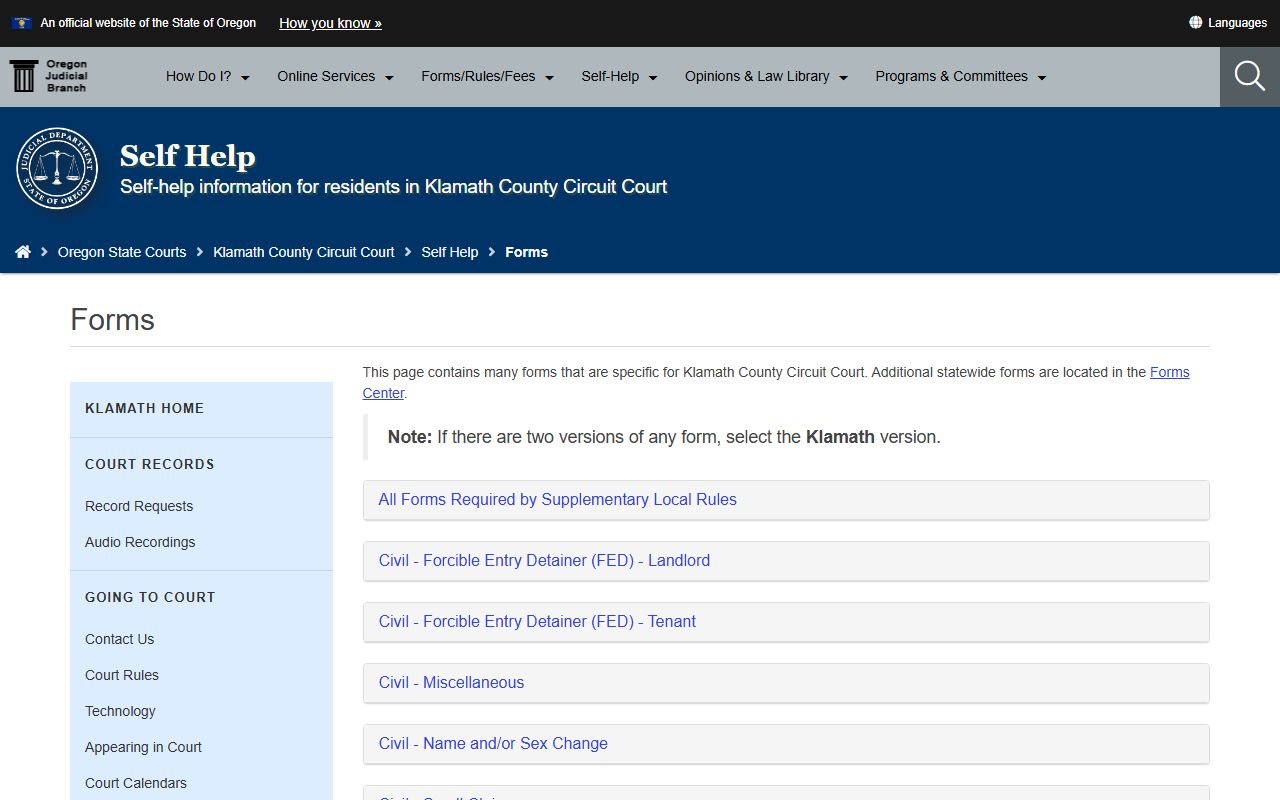
The forms source is useful before filing because probate, guardianship, and conservatorship filings are technical and local form choice can matter.
Klamath Probate Terms
Probate records use terms that describe the person's role and the type of court authority requested. The same Klamath County probate record can include more than one role, such as an estate personal representative plus a fiduciary letter used to prove authority to a bank or title company.
- Testator
- A person who made a will.
- Executor
- A person named to carry out a will. Oregon sources may also use personal representative.
- Intestate
- Dying without a valid will.
- Guardianship
- A court case about personal care or decision authority for a protected person.
- Conservatorship
- A court case about managing money or property for a protected person.
- Fiduciary letter
- A certified probate document showing authority to act for an estate or protected person.
Search Klamath Probate Records
Klamath County probate records may be located through OJD's online record search or OECI where case information is available. The public online record is often a register or docket, not a full scanned probate packet. Newer public documents may be reviewed on courthouse lobby kiosk computers. Older files that have not been digitized can require retrieval by the court.
The best search terms depend on the case type. Estate cases are often easier to find by the decedent's name or case number. Guardianship and conservatorship matters may involve a protected person, petitioner, proposed fiduciary, or appointed fiduciary. If only a bank, title company, or vehicle agency has asked for proof of authority, ask which exact probate document it needs before ordering copies. That can prevent buying a full file when a certified fiduciary letter or small estate affidavit is enough.
- Identify whether the matter is an estate, small estate affidavit, guardianship, or conservatorship.
- Search basic Circuit Court case information through OJD systems when available.
- Use the Klamath Circuit Court record request path for regular, certified, or exemplified copies.
- Ask for older or non-digitized files to be retrieved if the record is not viewable at the kiosk.
- Request paper certification when a bank, title company, Social Security office, or out-of-state agency needs a physical certified document.
Note: Probate records are Circuit Court records even when estate assets include land recorded with the County Clerk.
Klamath Probate Certified Copies
OJD's records request instructions specifically note that estate and probate certified documents, including fiduciary letters and small estate affidavits used to administer estates, may need paper certification. Electronic certified copies can be useful in many settings, but some third parties still require a paper certified copy with a visible seal, stamp, and clerk certification. A bank, title company, DMV office, or out-of-state agency may reject an uncertified printout even when the online case entry confirms that a probate case exists. Ask the receiving agency whether it needs a certified copy, an exemplified copy, a fiduciary letter, or the full order before placing the request.
Requesters should provide the case number and exact document name when possible. If the case number is unknown, party names, estate name, hearing dates, or filing dates may help staff locate the correct file. Klamath Circuit Court may take up to five court business days to respond and ten or more court business days to complete some requests. The court can ask for more information or payment before releasing copies, especially for older files that require retrieval.
| Probate Copy Item | OJD Fee / Note |
|---|---|
| Paper copy | $0.25 per page |
| Certified paper copy | $5 plus per-page copy charge |
| Exemplified copy | $10 plus per-page copy charge |
| Regular copies | $3 per case request plus per-page charge |
| Electronic document emailed | $3 per case request |
| Electronic certified copy | $5 |
| Mailing | Actual cost |
Klamath Probate and Recordings
The Klamath County Clerk records documents affecting title to real property, creates an index for retrieval, and microfilms recorded documents for archival storage. That office is close to the courthouse, but it is not the probate court. Probate court authority comes from the Circuit Court file. A deed, lien, or other land document may be recorded with the County Clerk after a probate order, but the order and fiduciary authority are court records.
The County Clerk recording page also lists document standards. Recording staff check documents for compliance with Oregon statutes, and documents that cannot be recorded are returned with an explanation. A $20 nonstandard form fee applies when instruments do not meet the cited recording requirements. Street addresses and tax lot numbers are not legal descriptions by themselves.
Klamath County Clerk's recording page explains recording duties and document standards separate from the probate case file.
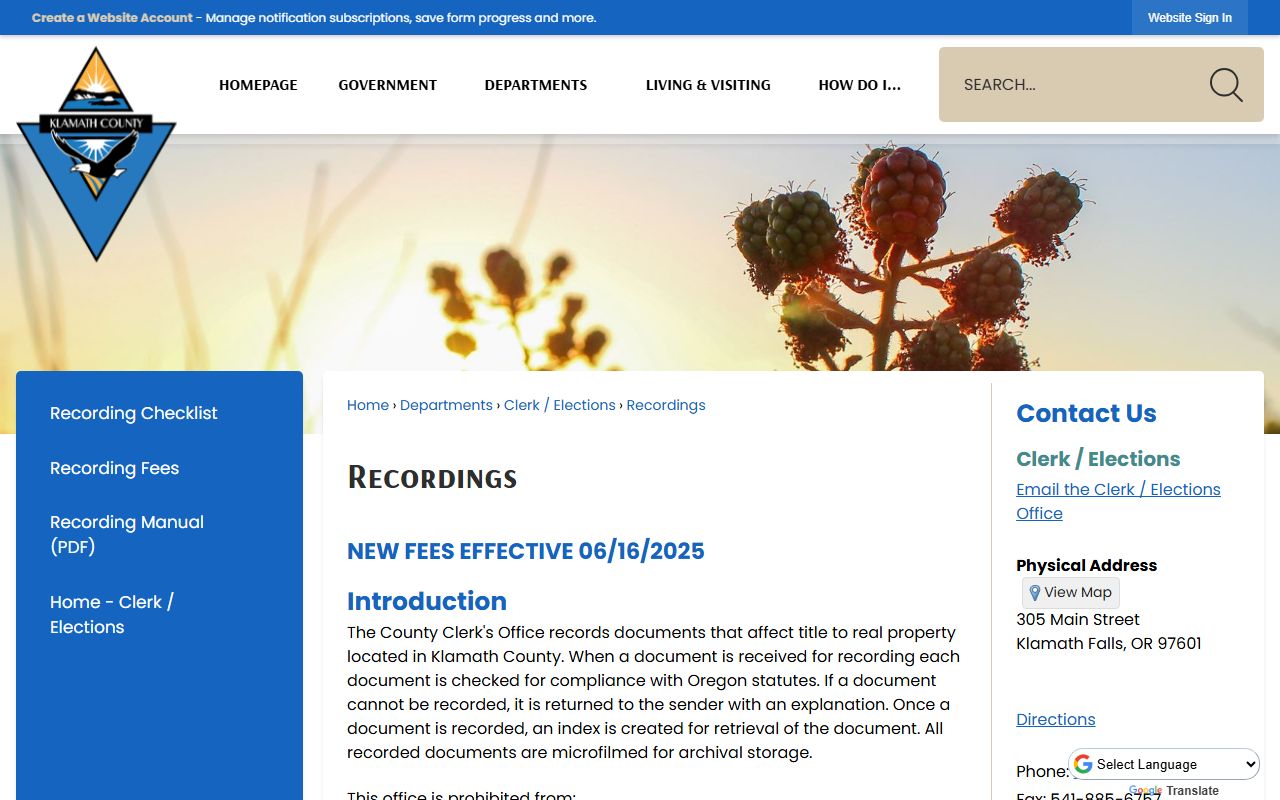
The recording source helps when estate administration also involves real property, but it does not replace the Circuit Court probate record.
Klamath Probate Access Limits
Probate is generally more public than adoption or juvenile court, but not every page of a probate file is open in the same way. Guardianship and conservatorship files may include medical, care, financial, or protected-person information. Public copies should not expose Social Security numbers, financial account data, or other protected identifiers. Oregon public-record law and court rules can require redaction or restricted access.
For related court access rules, ORS 7.020 defines the court register, while ORS 192.311 to 192.478 addresses Oregon public records access and exemptions. Adoption records are separately sealed under Oregon law and should not be treated as ordinary probate records.
Oregon juvenile and adoption confidentiality rules are also relevant when family history overlaps with estate research. A probate file may refer to heirs, beneficiaries, or protected persons, but that does not make sealed adoption or juvenile material open to the public. When a restricted document is needed for a legal purpose, the requester may need standing, a court order, or another statutory basis rather than an ordinary public copy request.
Klamath Probate Boundaries
Federal bankruptcy, federal civil cases, and tribal matters are separate from Klamath County probate records. PACER is the correct access path for federal dockets, including the U.S. District Court and Bankruptcy Court for the District of Oregon. Klamath Tribes Judiciary is also a separate tribal court system and should not be described as part of Klamath County Circuit Court.
Boundary questions come up often in estate work. A federal bankruptcy case may affect estate property, but it does not replace the Klamath County probate file. A tribal court filing may affect a person or family in a separate sovereign system, but it is not a Klamath Circuit Court probate case. A County Clerk recording may show a deed or lien, but the court order behind estate authority remains a court record. Keeping those systems separate makes the search more accurate.
PACER is the federal docket source, not a county probate search system.
The PACER source is useful only when the matter has moved into a federal court context, such as bankruptcy or federal litigation.
The Klamath County Sheriff's administration page identifies county law-enforcement leadership, which is separate from probate court administration.
That county source reinforces the need to route probate questions to the court, not to law enforcement or unrelated county administration offices.